Borehole heat exchangers
Precision drilling up to 500 m. Also in urban environments and with complex geology.
Geothermal · Since the 1980s
We have been drilling borehole heat exchangers since the 1980s — long before sustainability became a marketing word. Today we are among the most experienced pioneers in Switzerland and deliver everything from a single source: from the borehole to the connection.
Precision drilling up to 500 m. Also in urban environments and with complex geology.
Complete connection system — from probe to manifold. One single point of contact for the entire trade.
Management summary
Geothermal energy today covers around 5 % of Switzerland's heating demand — with enormous growth potential. A probe lasts up to 80 years, a system pays for itself after around 19 years (before subsidies), and federal and cantonal subsidies actively support heating replacement.
All figures, sources and FAQ →Heating & Cooling
Summers are getting hotter — and the same probe that heats in winter cools in summer. Something oil and gas heating simply cannot do. What is a bonus today becomes more of a given with every hot summer.
With free cooling only the circulation pump runs (~100 W) — no compressor. The brine draws the cool directly from the ground. Comfort as a by-product of the borehole.
The summer heat released into the ground recharges the probe for winter — stabilising efficiency and extending service life.
Unlike an air conditioner, geocooling needs no outdoor unit — nothing humming, nothing to disturb the neighbourhood.
Process
A borehole heat exchanger is more than a hole in the ground. Six steps, precisely executed — and the building heats itself from the depths for decades to come.
How long does a BHE take?
The drilling itself takes days — the permit dominates the schedule. Total from building application to completed system: 2–4 months (varies by canton, excluding upstream planning and preliminary clarification).
Structure plan for a typical Broder AG borehole heat exchanger project. Schematic — actual phase durations depend on project size, geology and the cantonal permit process.
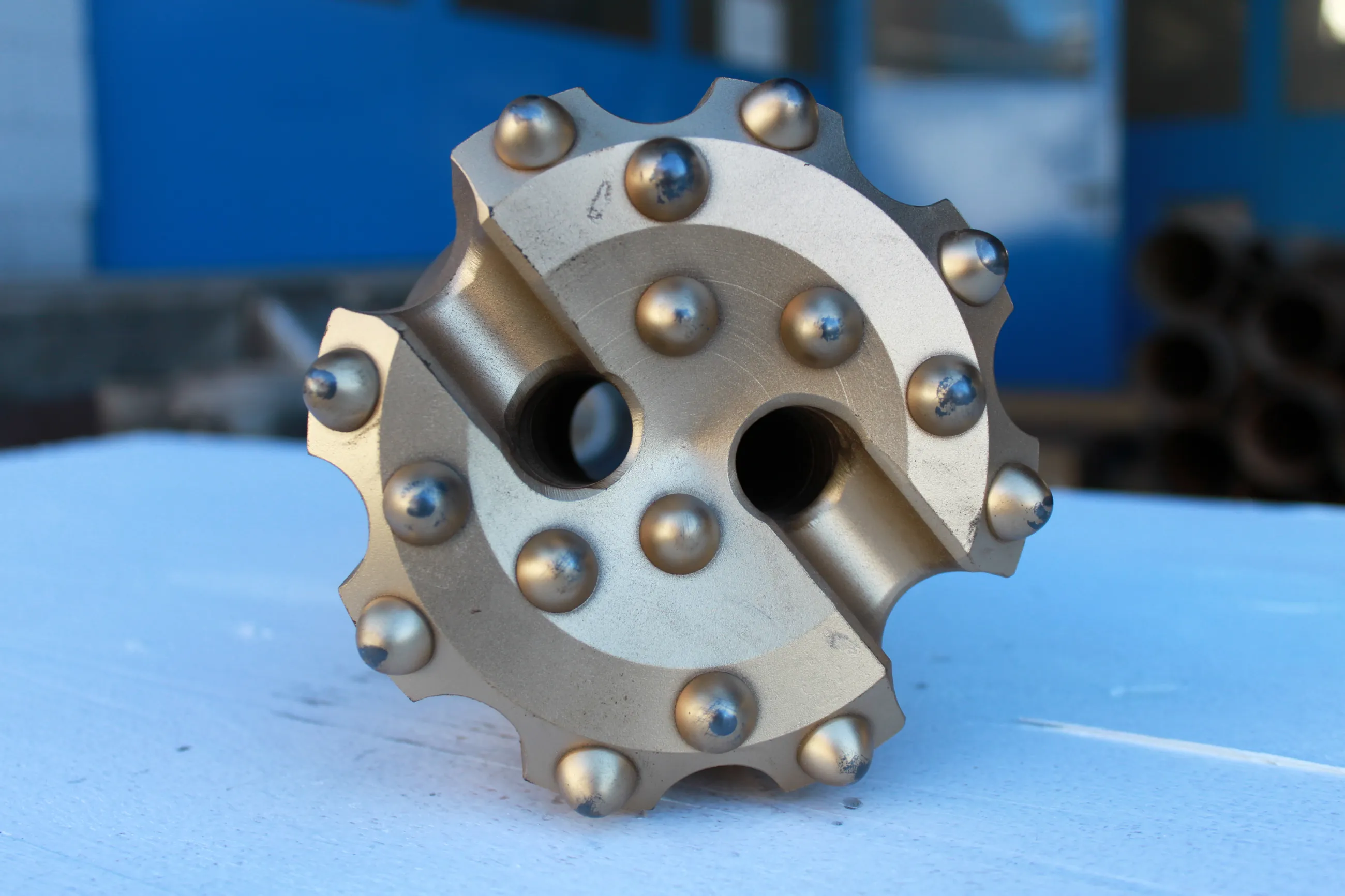
The tool changes with the layer — three bits from our workshop:


Technical standards
Fleet · drilling rigs & vehicles
Drilling rigs from established manufacturers in Germany and Italy — and four in-house designs from the Sargans workshop. This in-house engineering competence on Aebi and Unimog platforms is our central differentiator.
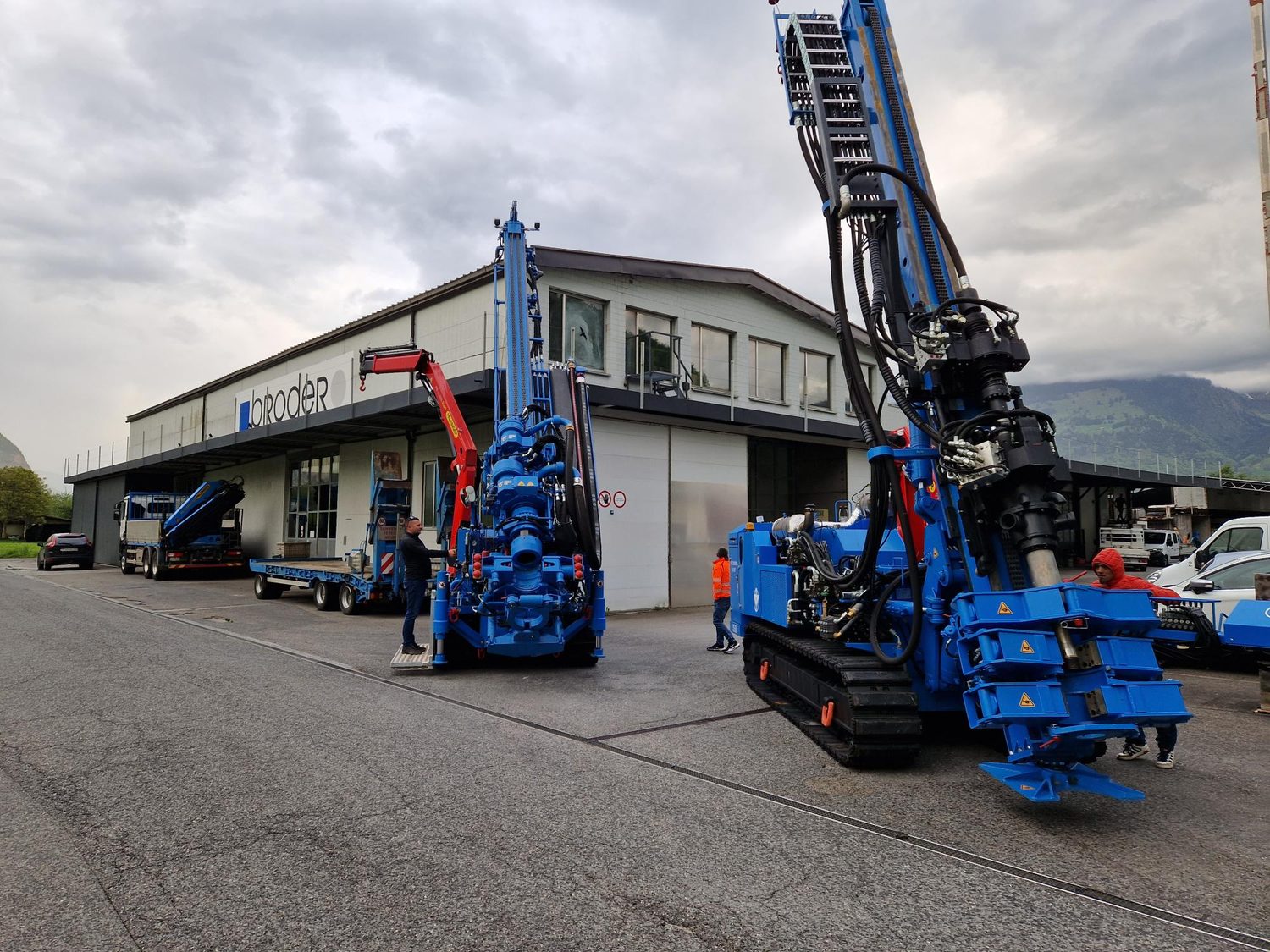
For over 90 years a leader in the construction of drilling rigs for geothermal energy, well drilling and geotechnics. Several machines in our fleet — from the compact crawler drilling rig to the fully hydraulic universal system.

Compact rotary drilling rig on crawler tracks. Exactly the right machine for tight spaces — single-family homes, infill drilling, courtyards.

Higher-performance variant with centrifugal pump — for deep probes and difficult geological conditions. Container and lift system from factory.

Fully hydraulic universal rig. Since 1973 with worldwide patented round drilling mast and integrated hydraulic feed. The workhorse for special foundation engineering.
Italian specialists for micropile, anchor and foundation drilling — successor to the traditional Brunello company. Several machines in our fleet, all on crawler tracks with a double rotary-head system.

Crawler-mounted hydraulic drilling rig in the upper power class. Double rotary-head system (S-DT) — highest production performance in our fleet. Two identical machines stationed in Sargans.

Crawler-mounted geothermal drilling rig with integrated hydraulic unit. Compact, precise, for limited space.
Four drilling rigs developed entirely in Sargans — based on Aebi and Unimog carrier vehicles. Our in-house competence is a unique selling point and the heart of the engineering and machine-construction business field.

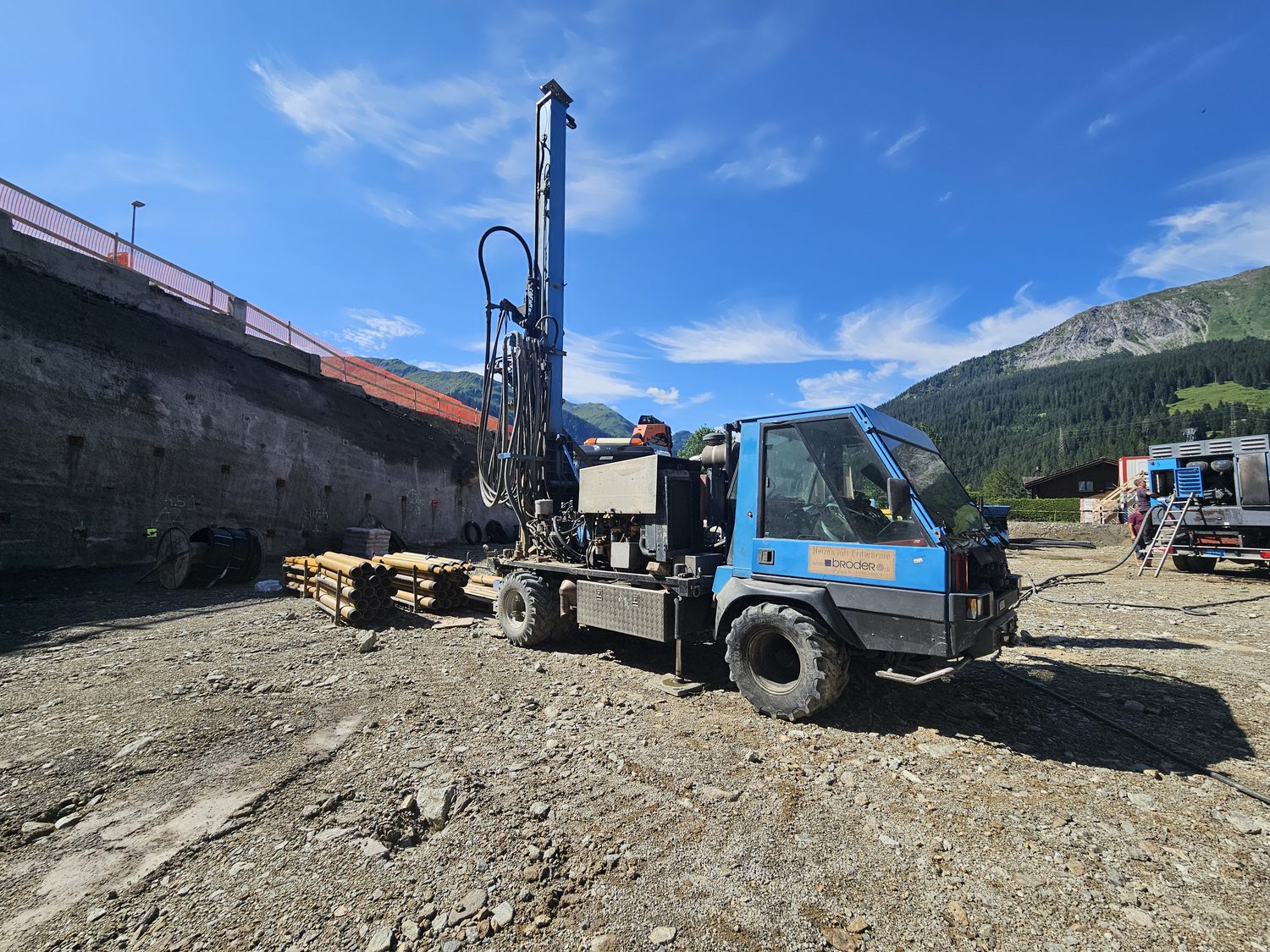
Hillside-capable transporter with mounted drilling mast — for steep locations and sensitive terrain.

Compact sister machine — smaller footprint, same agility in difficult terrain.

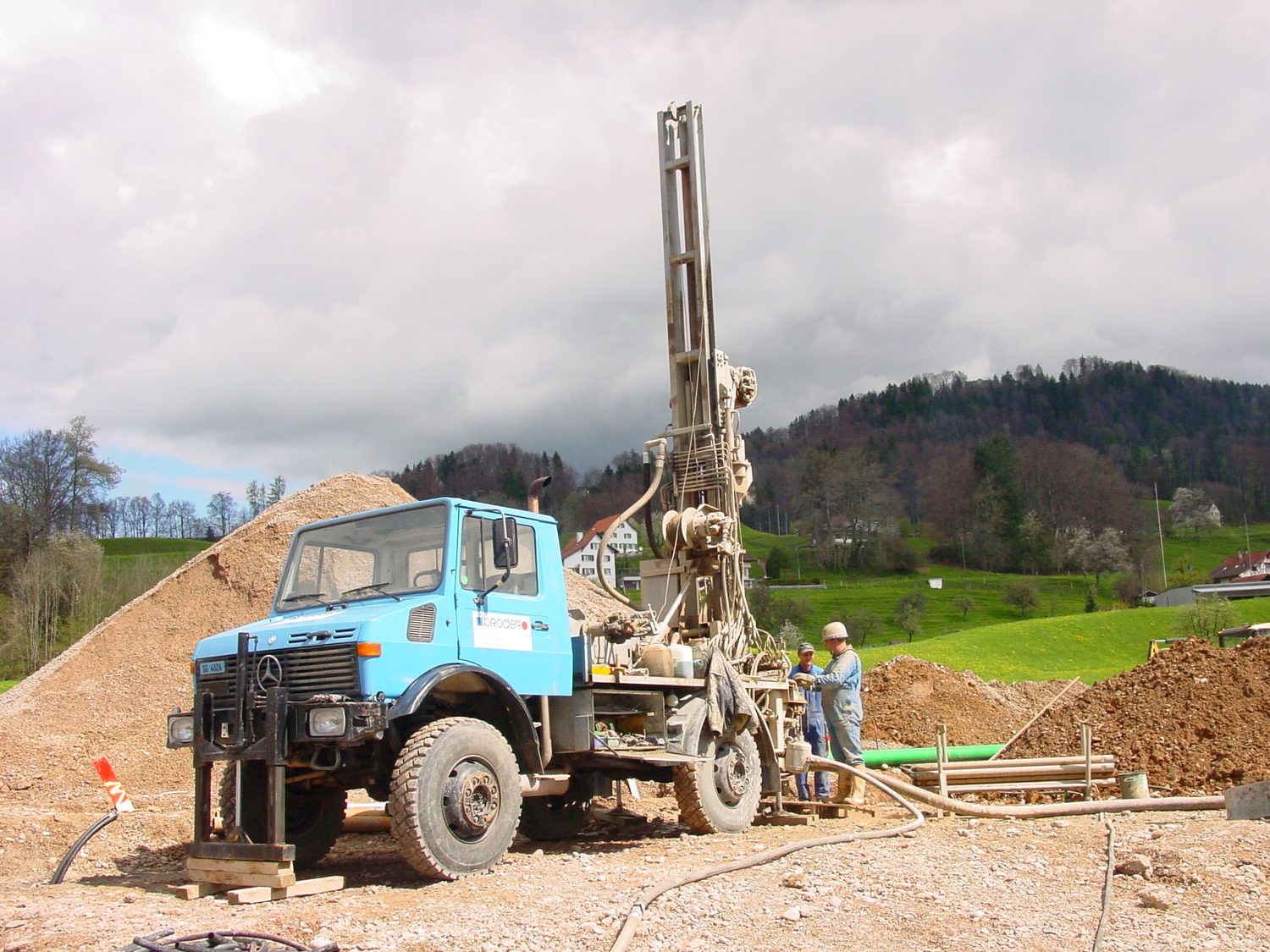
The Broder signature: Unimog chassis with in-house designed drilling mast. Road-capable and self-sufficient.

High-performance variant of the Unimog platform — higher production performance for demanding boreholes.
Every rig is run-in, maintained and rebuilt as needed in Sargans. Supported by trucks (9–12 m · up to 36 t), compressors, skip suppliers (Welaki), vacuum trucks (14 m³) and the Obermann pump VS 110-1-G/D — Q-max 170 l/min, P-max 100 bar, drive 24 kW.
Vehicles & equipment
From the heavy-haul Renault to the Aebi transporter with drilling mast. We get to where others can't — with the right equipment in tow.






Materials & manufacturers
Swiss manufacturer from Oberriet · PE 100 RC · double-U probes up to 400 m · our standard supplier for CH projects.
Swiss brand · cross-linked PE 100 RC · specialised in crack-stop resistant geothermal pipes · for special depths.
Pre-insulated PE-X composite pipes · for horizontal connections over long distances · lower heat loss.
Swiss geothermal specialist · probes & drilling technology · own developments: diffusion-tight probes, depths down to 1'000 m.
Product certifications
Every borehole, every probe, every grouting complies with the relevant Swiss and European standards. The most important certificates and standards we work to.
Swiss standard for borehole heat exchangers. Sizing, execution and operation to the current edition.
Award from the Swiss Heat Pump Association recognising quality and care in drilling operations.
Diffusion-tight, cross-linked polyethylene — at least 50 years service life per SIA 384/6, material certified by the manufacturer for up to 100 years.
Procedures and grouting to SVGW and cantonal groundwater-protection requirements. Seamless borehole documentation.
Our warranty promise
We build systems that outlive us — and we stand behind them accordingly. Three promises that have accompanied every handover since 1961.
Every borehole is surveyed, every pressure test recorded. Borehole documentation, grouting record, handover report — all archived.
From permit to commissioning you stay with one person. Sargans, personal, no call centre — reachable on site.
On probe and grouting we give the SIA-compliant warranties — designed for at least 50 years per SIA 384/6, the PE 100 RC material for up to 100 years. The heat pump can be replaced, the probe stays.